
Retailers have largely solved the challenge of producing better forecasts. The next challenge is making thousands of planning decisions faster and more consistently across organisations where supply chain, pricing, promotions and merchandising still operate in silos.
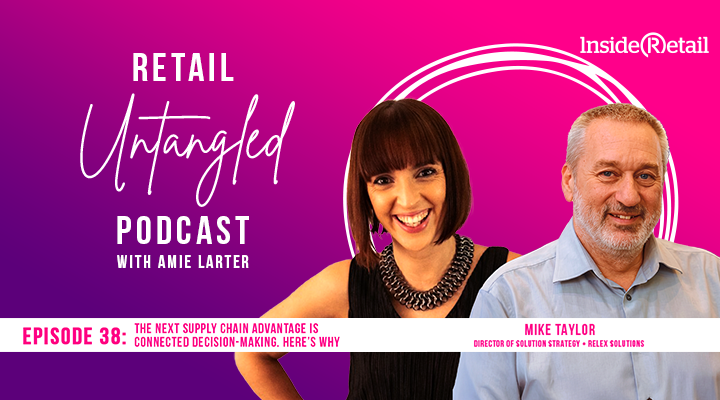
Mike Taylor, director of solution strategy at Relex Solutions, argues that the next competitive advantage is not so much around predicting demand, but more about connecting every planning decision that follows.
Much of the past investment in planning software has been made in silos, leaving organisations where the supply chain is disconnected from space and assortment planning, which is in turn disconnected from price and promotional planning.
“They don’t talk to each other, and that is where a lot of the value can now be unlocked in seamless planning across the organisation,” Taylor told Inside Retail’s Amie Larter in the latest edition of her podcast Retail Untangled. This is the result of retailers investing in static systems that cannot scale with the business and thus quickly lag behind compared with the latest technologies and capabilities available.
Relex provides a unified, AI-native platform for retailers to improve forecast accuracy, optimise inventory, pricing, merchandising, and production, and seamlessly plan from production to shelf.
Taylor says that retailers who adopt agentic AI in the supply chain can move many of the recommendations from software solutions into a more intelligent, automated execution. That starts by connecting back-end functions and eliminating the silo effect, and allowing analysis to be completed much faster than most retailers’ current development cycles would allow.
Let retailers focus on retailing
That process allows planners to return to being retailers again, he explains, adding their experience and doing the things the machines cannot do, “which is more of the feel of retail”. That, he says, involves building trust, which will take time. The ultimate objective of using agentic AI is that once trust is built, and the system is refined, the retailer can adapt from having humans make the final decisions to trusting the system to move into an autonomous environment.
“That will take time, and that is an important distinction for any executive.”
Retailers have spent decades building processes where humans make that final call on replenishment, ranging, and inventory positioning. To get a retail organisation and its leadership to genuinely trust the decisions of an autonomous system requires time and transparency, he says.
“Over the last 20 years, we have built very sophisticated systems that use machine learning and complicated and sophisticated optimisation techniques. Our philosophy is that we provide transparency in the answers that the machine is providing and the things that it’s doing.”
Taking away the black box
By transparency, he means explaining how they got to the answer – “taking away the ‘black box’” – and making sure the rationale is visible.
“That builds trust over time. We found that with planners moving on to our systems, they’ll take their time in the first instance to look at the answers, find out what’s under the covers before they start to trust. Then they start to trust, and then they stop looking because they know what they’re getting and they can rely on it.
“The same is now true of agentic AI in this autonomous world: For now, it is very much about transparency. How did you get to that answer? What steps did you take to go through the thinking process?”
The retailers who adopt this technology need to ensure they can examine that process and understand what is happening. Then, over time, they will learn to trust the system because it’s producing consistently accurate results.
“It is incumbent on us as a software provider to give you the tools as a retailer to be able to examine what is going on under the covers. If we just hide it underneath the bonnet and nobody gets to see what’s going on, then it’s going to be a long journey to building to trust.”
The Superman conundrum
Ultimately, Taylor believes the real test of a retailer’s supply chain isn’t how well it performs when its most experienced planner is at their desk, but how well it performs when they are not.
Too many organisations still depend on a handful of “superhero” planners whose knowledge and judgement keep operations running smoothly when disruption strikes. While those individuals are invaluable, relying on them exposes a deeper weakness: critical decisions remain embedded in people rather than in resilient, connected systems.
As autonomous planning matures, that dependency should begin to fade. “The goal is not to remove human expertise from the equation, but to elevate it – freeing planners from repetitive operational decisions so they can focus on strategy, customer needs and the commercial judgement that technology cannot replicate.
“For retailers weighing their readiness for the next generation of AI, the question may be simpler than it first appears: If your best planner wasn’t in the room tomorrow, would your business still make the right decisions?” he concludes.
- Listen to the podcast to hear Taylor explain how accurate forecasting can deliver a significant competitive advantage to retailers, and how implementing agentic AI-driven planning solutions will impact teams who have spent their careers specialising in forecasting (it is not what you may imagine).


