
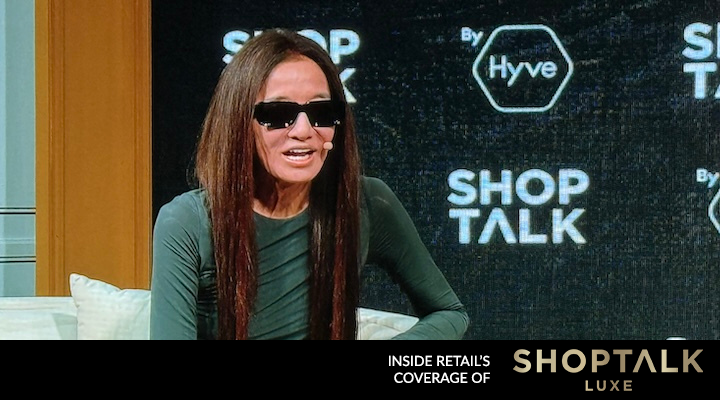
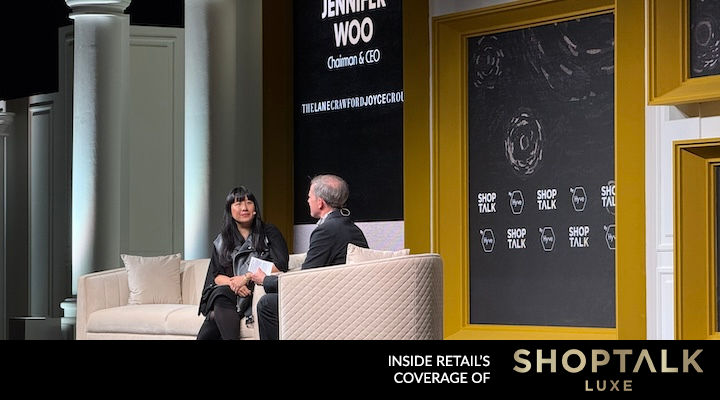
Shoptalk Luxe wrapped up in Abu Dhabi on Thursday with keynote presentations from two high-profile fashion experts: American designer Vera Wang and Hong Kong retail executive Jennifer Woo, who heads Lane Crawford, the luxury department store chain.
They have very different backgrounds, but a common theme of their presentations was endurance. Wang, 76, known for iconic bridal gowns and ready-to-wear, discussed the cornerstone of her brand, built over 36 years before selling in 2024. Woo addressed the question of how to future-proof a 175-year-old business and what the future holds for a retail category many commentators want to write off.
How Vera Wang built an emotional brand
Wang learned the ropes of the fashion industry as a senior editor at Vogue before joining Ralph Lauren, a designer who would become her mentor.
Lauren taught her never to digress from her vision, no matter the noise around you; he stayed true to his brand. “That was a valuable lesson… on every level. For me, maintaining the code of our brand – and hopefully the respect and the love and the loyalty of the client – are among the most important things.”
Fashion today might be changing faster than ever, partly due to technology and younger generations who, in the digital age, are easily distracted and move quickly. However, fashion is not necessarily about change, she argues. “That’s why people like Chanel and Ralph Lauren. Those brands are so unusual because they manage to keep their codes.”
Nevertheless, she sees a need to experiment more in the field of couture. She admires external investors in fashion businesses for being willing to shake the industry up and experiment more. “In a way, it is quite courageous and quite necessary.”
When Wang looks back on the brand she founded in 1990, bearing her name, the long journey since – including its sale to WHP Global in 2024, after which she transitioned into the role of chief creative officer – was valuable, exciting and unique.
“I’ve been exposed to things most people never ever experience. I got to work with photographers like Richard Avedon and Irving Penn (at Vogue), incredible icons. And going to Ralph Lauren, where I saw an incredible brand and how it was carefully built and protected for a very long time.”
The hard part of the journey, she shared, was becoming a businesswoman. “I’m an artist, and I started off as an artist, but fortunately or unfortunately, I really had to become a business person.” Since WHP took over, she has enjoyed not having to worry about finances every day.
Even though the brand bearing her name has new owners, she knows WHP respects the brand to begin with and appreciates that the founder is still alive and kicking. “I’m not sure kicking is the right word,” she quips, “so let’s just say around. I hope they’re not totally annoyed with [me], but it is our first year, and I guess we are in that honeymoon stage.” She feels a shared excitement and creative freedom as they work to build the brand’s lifestyle position.
So what gives a fashion brand endurance? “It is ultimately about taste, a particular taste, a certain style, a certain mood, and a certain dedication and respect for the brand. If you keep that consistency, which we have always tried to do, that defines a brand that has lasting power.”
For most fashion purchasers, emotion is a driving force in the decision-making, she furthers. Whether a wedding day or taking to the stage at the Oscars, those are the biggest emotional moments of the customer’s lives.
“When you are a part of that, it is not just a dress; it is a vision of themselves that you are translating.
“Ours is an extremely emotional brand. And you have ever seen a bride-to-be, or her mother, or her future mother-in-law, it is extremely challenging at times; joyful, but challenging. You really learn about human nature. You get to know a family really well by then. And when you spend that much time with a client, which is unusual in any other aspect of fashion today, you become a part of the family, a psychiatrist, a dressmaker; there are many roles that you play. We have had an emotional connection to every single person that we have touched globally for 37 years,” said Wang.
“I hope my brand survives me forever. I think of it as a kind, loving, romantic brand. But more than anything, it is emotional.”
Jennifer Woo: We are a relationship business, not a transactional business
Hong Kong-headquartered Lane Crawford has four department stores in the city and two more in Mainland China, as well as an online store. Combined, they serve around 2 million customers across 30 cities in the region. Unlike a more traditional department store, Lane Crawford focuses on a few categories: Fashion, accessories, jewellery, beauty and homewares.
“Our model is very compact, because we operate in one of the most dense real estate markets in the world, with expensive rents and showcases. That means we have to really be on our toes with our business.” Furthermore, Lane Crawford is unique among department stores globally for buying its stock from some 800 brands; it does not lease concessions to labels.
“We are a relationship business. We are not a transactional business,” Woo explained. “We love department stores, and we believe in tailoring experiences for our customers, owning that journey from the beginning to the end.
So, to answer the question: What is your take on the future of the department store? Woo turns the question about face: “If the merchant craft is done well, and you are thinking about it for the long term, why would a department store not be fit for purpose?”
Woo believes it is important to empower team members with flexibility to work with customers and meet their needs. She cited two examples of how the company walks the talk when it comes to being customer-centric.
In the first, a customer walked in off the street, explaining to an associate that they had just arrived in Hong Kong and needed to fit out a home they had leased, but were pressed for time. The associate offered to bring prospective items to the customer’s home. After several subsequent phone conversations to get to know the customer and understand their style, an associate loaded a truck with items they thought would work.
“By the end of the day, the customer bought everything in the truck, except for two things – an ashtray and a whiskey decanter – because he doesn’t drink or smoke.
The second story is about a customer who had moved from Hong Kong and was coming back for a short trip, landing at 10.30pm and leaving the next morning at 6am. He told the associate he could not visit the store because it would be closed.
“We opened a store for this individual, and they had a reunion, a midnight feast, and the customer didn’t leave the store until 2am for his 6am flight.” But how did the associate get approval to open the store?
“Our playbook for customer service and relationships is that we don’t have one. Our mandate for our sales staff is to build and deepen relationships. Our job as an organisation is to enable them to do that, with tools and support, and we give them a budget to be able to entertain their customers. We give them a portfolio of 100 to 150 customers to deepen those relationships.
“We need to empower our associates and give them the tools, so if they want to book a truck or open a store, it is within their remit.”
Woo says the retailer leaned into the relationship business after experiencing trading challenges in the region over the years, leading up to and during Covid. (Think politically motivated street protests, then lockdowns). Senior management was also growing bored with department store offers they saw internationally – “to be honest, we were seeing the same things everywhere around the world”.
Developing the relationship-focused business strategy unlocked a more human element to customer interaction, she recalls, “an opportunity that just keeps on giving”.
“The third reason is we were coming off two decades of huge growth … and that changed dramatically. So we had to redefine what growth means. Brick-and-mortar usually means expansion through more bricks, more stores. But for us, that might not work in the current environment. So we needed to look at how we could grow through our people.”
‘The future is human-centric’
“Department stores are usually built to last, not to change, and that can’t go on anymore. We have to build them to change in order to [survive], so we can no longer operate under a silo mentality, department by department. We need to layer human systems into these to break the rigidity of department stores, so that there is more fluidity, more stretch, and more imagination in what we have made together.
“So adjusting us to be more human-centric, rather than department-centric, and that deep feeds into the mastery of our craft.
“A lot of people talk about high-performance hitting targets; that’s great. I love hitting targets, but not at the expense of the product. Mastering a craft takes season after season, and you get better and better at it,” continued Woo.
“Every season, we have the opportunity to do things better and better. And when you do that really well, the bottom line will come, the top line will come, and our relationships will deepen and grow.
“The neat definition of growth for us is through people. That’s the only way that department stores can keep their feet on the ground and close to the community; to go full circle to be the centre and hub of any community.”
- Keep an eye on Inside Retail over the coming days for more Shoptalk Luxe reports.


